
Millions have watched the Ramayana. Yet, almost nobody knows the true story of how Lakshman died. His departure is not shown in most television versions. Still, it remains one of the most heartbreaking moments in all of Hindu scripture.
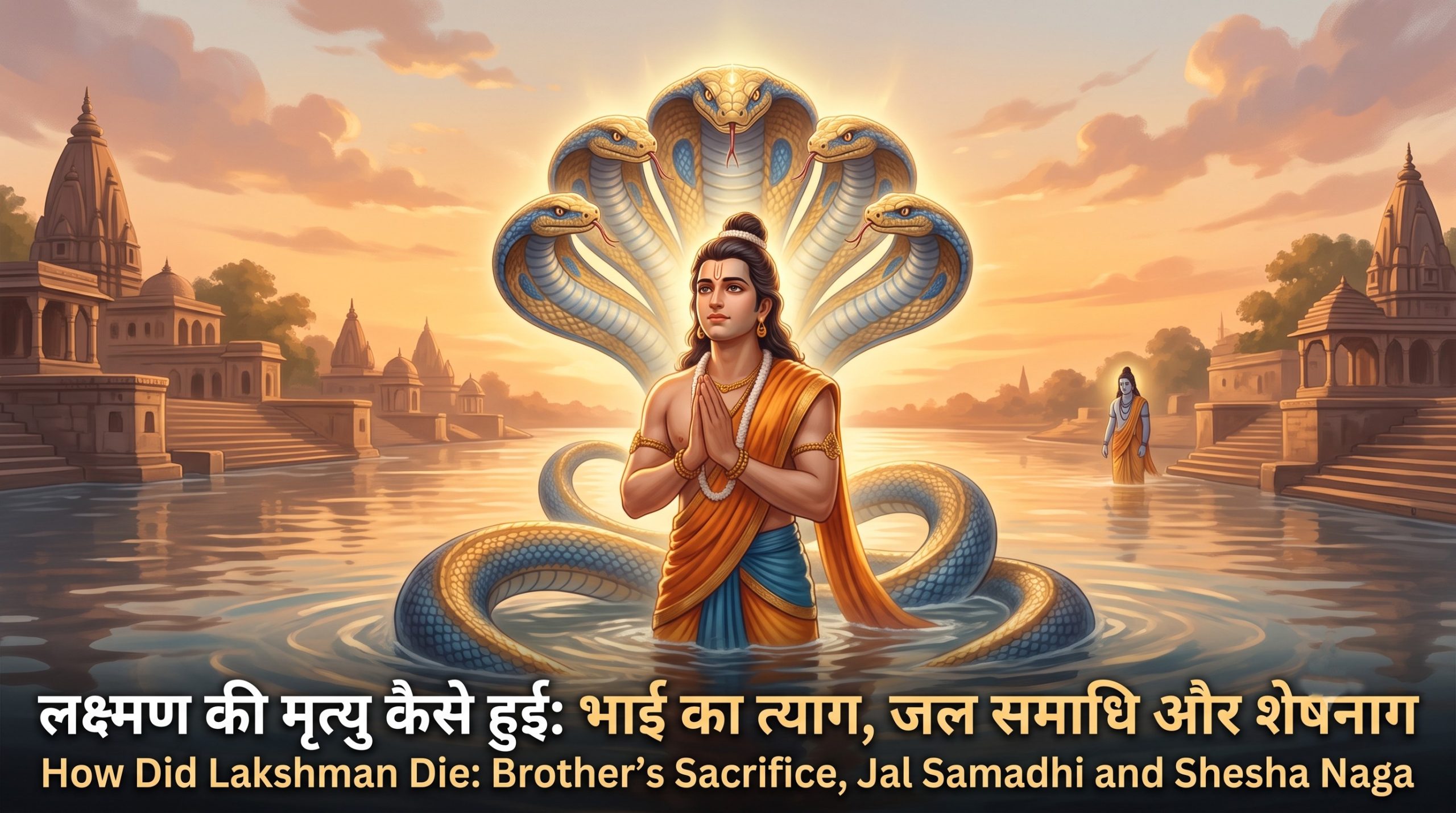
To understand how Lakshman died, we must look beyond ordinary death. He did not pass away due to age or battle. Instead, he walked into the holy Sarayu River. He took Jal Samadhi and returned to his eternal, divine form as Shesha Naga.
Why did this happen? It all started with a secret meeting and a binding promise. This blog covers the real story behind his departure. You will learn about the intense dharamsankat and the sacred vachan that forced this separation.
Finally, we explore the deep spiritual meaning of Jal Samadhi. Read on to discover this beautiful, untold tale of the greatest sacrifice and devotion.
The Aadi Swaroop: What Was Lakshman Before His Manav Avtar?
King Dasharatha’s third son, Lakshman, was the twin of Shatrughna. He was the very shadow of Ram’s soul. His devotion defined his entire life. During their 14 years of Vanvaas, Lakshman made a sacrifice.
He completely gave up sleep for 14 years. He did this so Ram and Sita could rest safely. Every single sleepless night became a profound act of pure love. However, Lakshman was not just a dedicated human brother.
To understand his departure, we must look at his Aadi Swaroop (original divine form). Lakshman was the earthly avatar of Shesha Naga, the eternal cosmic serpent. In Vaikuntha, Lord Vishnu rests upon the coils of Shesha Naga.
When Vishnu descended as Ram, his eternal companion followed him to serve. To see the reality of the Ramayana, we have to look past the idea of a normal human ending. If we view his departure as just a sad event, we miss the entire spiritual truth of the shastras.
He was not a helpless human. His work on Earth was over, and it was simply time for Shesha Naga to drop the Manav Avtar with complete grace.
The Gupt Baithak: How Saving Ayodhya Became Lakshman’s Destiny
The intense chain of events started when Yama, the God of Death, arrived at the palace. He came to remind Lord Ram that his mission on Earth was now complete. However, Yama wanted to speak in absolute privacy.
He put forward a strict condition before the talk began. Whoever interrupted their secret meeting would face a mandatory death sentence. Ram accepted the term and placed Lakshman at the door as the ultimate guard. While the secret meeting was going on inside, Sage Durvasa arrived at the palace gates.
Known for his fiery anger, the sage demanded an immediate audience with Ram. Lakshman politely asked him to wait for a few moments. This request instantly enraged the sage. Durvasa gave a terrible ultimatum.
If he was not allowed inside right that second, he would curse the entire royal family and burn the city of Ayodhya to ashes. This put Lakshman in a Dharmasankat. If he stayed outside, Durvasa’s curse would destroy all of Ayodhya.
If he went inside, he knew he would have to die. For Lakshman, the choice was simple. He gladly chose to die rather than let his kingdom burn. He opened the door, broke the rule, and saved his people. This very moment broke the hearts of everyone in the palace.
Ram’s Dharamsankat: What Turned a Divine Vachan Into a Brother’s Sacrifice?
Lord Ram was now completely trapped by his own divine promise. He had given his word to Yama, and as Maryada Purushottam, he could never break a vow.
The Bound Vow (Kaal Ka Vachan)
Ram was completely bound by his own strict promise to Yama. He had given his word that whoever broke the privacy of their meeting would face a mandatory death sentence. As a king who always stood for truth, breaking his word was out of the question.
The Unthinkable Dilemma
At the same time, executing Lakshman with his own hands was totally unthinkable. Breaking his dharma would destroy everything he stood for, but punishing Lakshman would kill his own soul. Ram was completely frozen in deep pain.
The Solution
Seeing Ram’s suffering, Rishi Vashishtha came in with a solution from ancient laws. He explained that in Vedic texts, public abandonment is considered exactly equal to death. This gave Ram a painful way out to keep his promise without killing his brother.
Banishment of the Soul (Aatma Ka Tyag)
With a broken heart, Ram formally ordered Lakshman to leave Ayodhya forever. He was essentially forcing his own shadow and his own heartbeat to walk out of his life.
Aakhiri Samvaad
The last words shared between the two brothers before Lakshman walked away broke the hearts of everyone in the palace. It was a silent, heavy end to a lifetime of unparalleled love.
The Jal Samadhi: What Was the Reality Behind Lakshman’s Antim Yatra?
After leaving the palace of Ayodhya, Lakshman walked toward the Sarayu River with complete peace. With no anger or regret in his heart, but only a deep sense of devotion as he prepared to return to his true form.
The Silent Walk (Maun Yatra)
Lakshman did not fight his destiny, nor did he weep over his exile. He walked all the way to the banks of the Sarayu River with folded hands and closed eyes. His quiet strength showed that he completely accepted this heavy moment as part of a larger divine plan.
Jal Samadhi
Stepping into the water, Lakshman performed a sacred Jal Samadhi. This was not an act of ending one’s life in despair, but a voluntary departure from the physical body through holy water. It was the yogic surrender, where a divine soul willingly decides that his mission is over on earth.
The Choice of Sarayu (Pavitra Sarayu)
The Sarayu River was specifically chosen for this final journey because it is the most sacred river of Ayodhya. More importantly, the scriptures consider it a direct manifestation of Lord Vishnu. Merging into its waters meant Lakshman was directly stepping back into the divine source.
The Witness (Devlok Ka Aashirwad)
As Lakshman stepped deeper into the river, flowers rained down from heaven, and divine music filled the entire air. The gods themselves gathered in the skies to bear witness to his departure. They were not mourning a loss, but celebrating the return of a cosmic power.
Returning to Shesha Naga (Moksha)
Just like that, Lakshman merged into the Sarayu River. He did not die a painful death; he simply chose to go back home. He quietly left his human body behind and became Shesha Naga once again.
Ek Anmol Jivan Darshan: What Lakshman’s Sacrifice Actually Teaches Us
Lakshman’s final journey looks sad, but the holy books show it differently. His story teaches us huge lessons about life, duty, and faith. It shows us what happens when a person lives entirely for a higher, divine purpose.
- Beautiful Freedom – Lakshman’s story is not a sad tragedy. It is a beautiful example of a soul freely deciding to leave its body and return to God.
- The Cost of True Love – His sacrifice answers a big question. It shows that complete devotion means being ready to give up your most precious things for God.
- A Calm Departure – His choice to enter the water was filled with peace. It shows how a pure soul leaves the world with zero fear and full awareness.
- A Pre-Planned Story – The Valmiki Ramayana reveals that this was not a sudden accident. It was all a cosmic plan to bring both divine brothers back home.
- Duty Above Heart – This story shows that doing the right thing is never easy. Sometimes, your duty makes you choose things that hurt you the most.
- The Perfect Leader – By keeping his promise even when it broke his heart, Ram proved why he is a true king who treats everyone equally.
- True Bond Lasts Forever – Ultimately, Lakshman teaches us that bodies can fade, but real love and devotion stay alive across different worlds.
Conclusion
Many people ask How did Lakshman Die, but his story is not about a sad death. Instead, he simply finished his work on Earth, left his body, and went back to his true home. Every single day of his life was filled with deep love for Ram.
From the sleepless nights in the forest to his final, quiet walk into the Sarayu River, every step he took was for his brother. His life teaches us what true love, duty, and sacrifice really mean. His work on Earth was completed, and it was time for Shesha Naga to drop the Manav Avtar with complete grace.
This story helps us see that physical life is temporary, but devotion lasts forever. Explore more stories from Ramayana and Vedic wisdom on 99Pandit, India’s most trusted spiritual platform. It is the best place to connect with our rich culture and find peace.