
Introduction
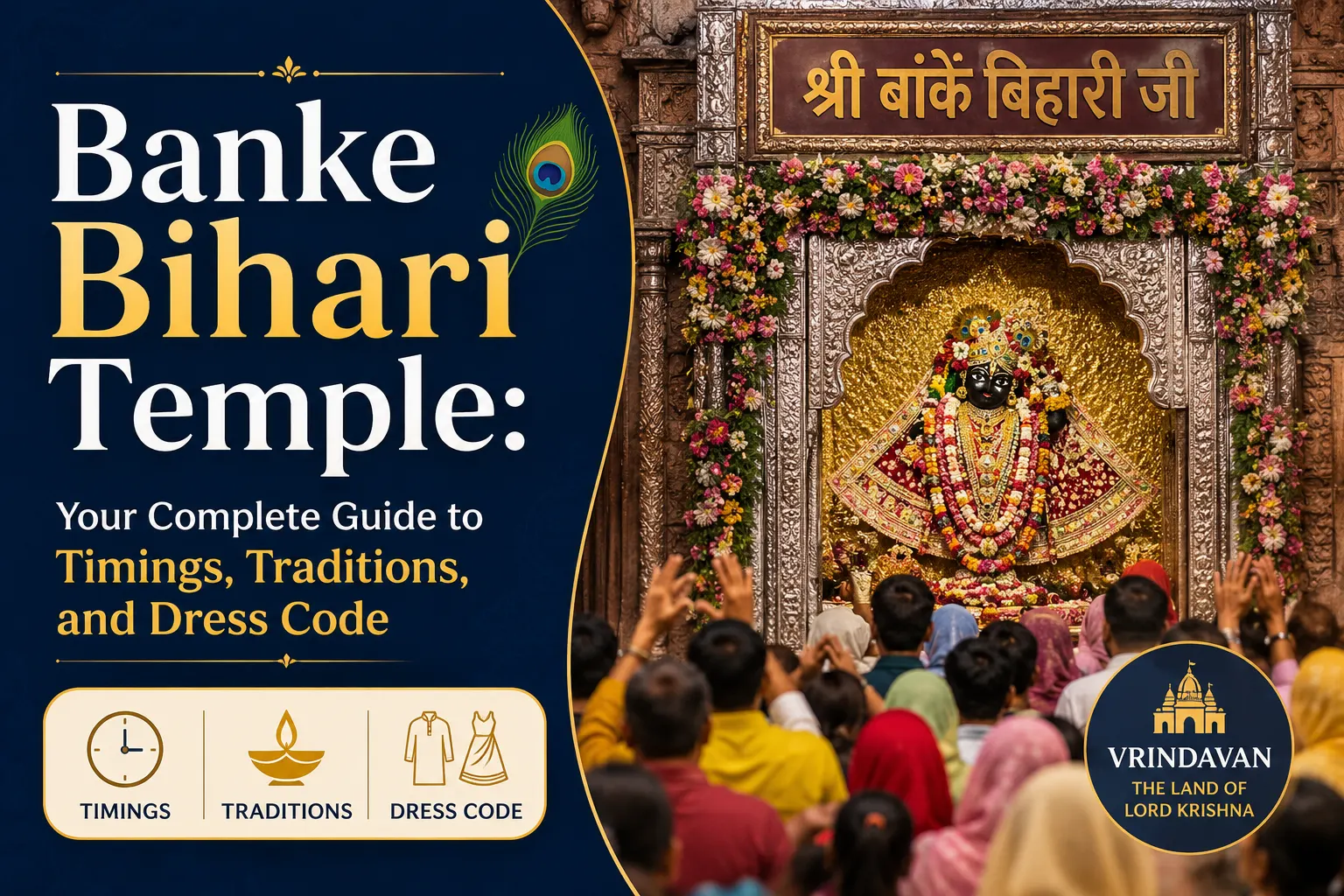
Have you been planning a visit to one of India’s most beloved Krishna temples? The Banke Bihari Temple in Vrindavan is unlike any other sacred site in the country.
It is lively, deeply spiritual, and rooted in centuries of devotion.
Thousands of pilgrims visit every single day to seek the divine darshan of Bihari Ji — the playful and enchanting form of Lord Krishna.
But visiting this temple is not just about showing up.
To truly experience its magic, you need to know the timings, traditions, dress code, and a few unique rules that set this temple apart from all others.
In this complete guide, you will find everything — from the temple’s history and meaning to what to wear, when to go, and which festivals to witness. So read on and plan your visit with confidence and clarity.
What Is the Banke Bihari Temple?
The Banke Bihari Temple is a famous and holy temple located in Biharipura, Vrindavan, in the Mathura district of Uttar Pradesh, India.
It is one of the most popular temples dedicated to Lord Krishna in the entire country.
The name “Banke Bihari” carries deep meaning. “Banke” refers to Krishna’s famous tribhanga posture — bent at three points: the neck, waist, and knee. “Bihari” means the supreme enjoyer.
Together, the name describes the joyous, playful, and all-attractive nature of Lord Krishna.
The temple draws devotees not only from across India but from all over the world.
It is a spiritual centre, a cultural icon, and a living tradition — all in one sacred space.
History of Banke Bihari Temple
The Legend of Swami Haridas
The story of the Banke Bihari Temple begins with Swami Haridas, a 16th-century saint, musician, and great devotee of Lord Krishna.
He is also known as the guru of the legendary musician Tansen, one of the nine gems of Emperor Akbar’s court.
Swami Haridas dedicated his life to devotional singing in the forests of Vrindavan — particularly in Nidhivan, one of Vrindavan’s most sacred groves.
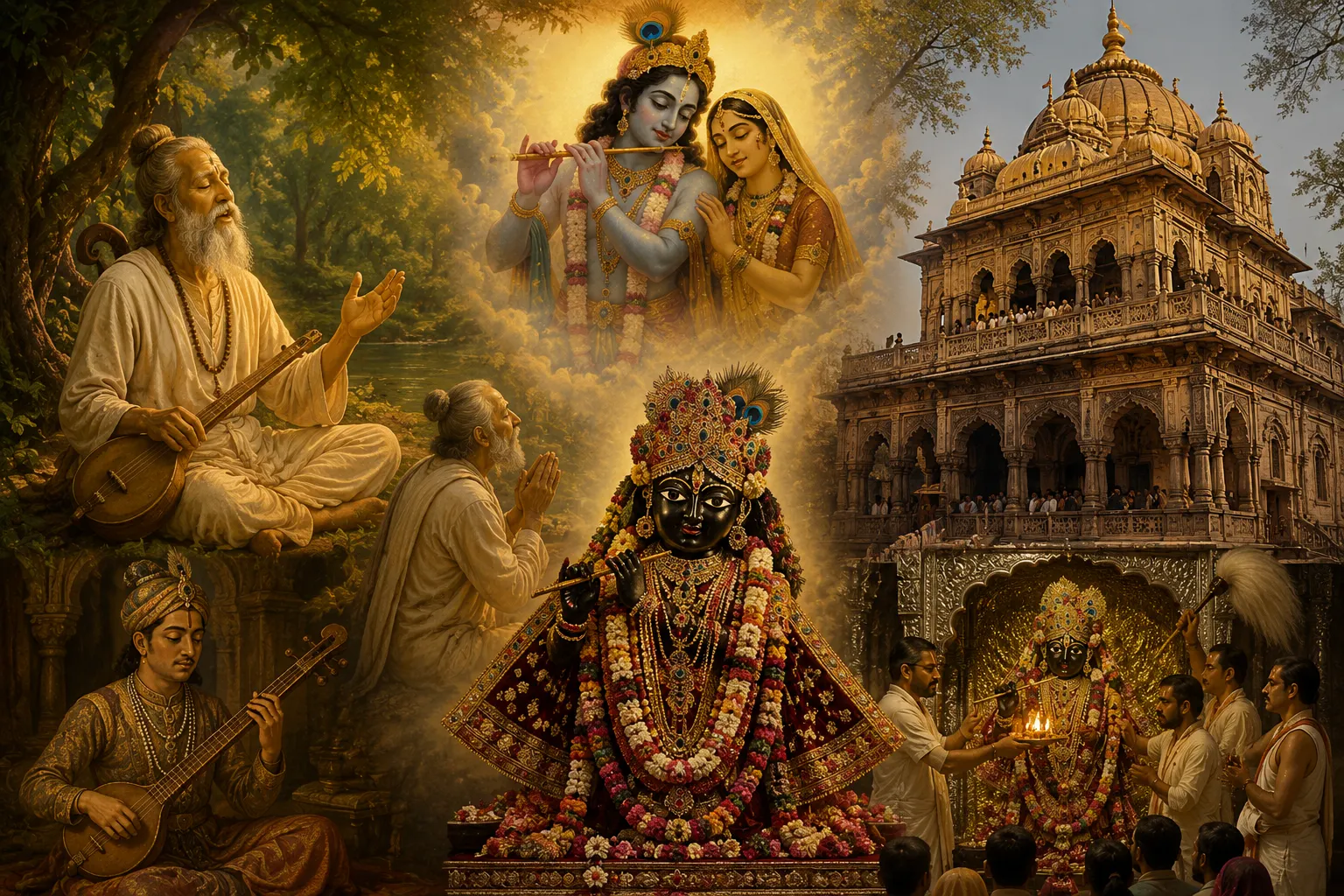
According to tradition, Swami Haridas’s deep devotion and beautiful singing moved Lord Krishna and Radharani to appear before him in their divine forms.
However, the radiance of the divine couple was so intense and brilliant that human eyes could not bear it.
Sensing this, Swami Haridas requested them to take a form that every devotee could see and worship.
In response, Radha and Krishna combined into a single beautiful black idol — and this is the Banke Bihari form that is worshipped to this day.
From Nidhivan to the Present Temple
Originally, the sacred idol was worshipped in Nidhivan as “Kunj-Bihari” — the enjoyer of the groves of Vrindavan.
The present temple building was constructed in 1862 by the Goswami successors of Swami Haridas, and the deity was then moved to this location.
Swami Haridas handed the seva (service) of Lord Banke Bihari to Goswami Jagannath.
This sacred duty has continued through generations, with family members of Goswami Jagannath still performing the temple services today — keeping alive centuries-old traditions and worship methods.
Significance of Banke Bihari Temple
The Banke Bihari Temple holds a special place among Krishna devotees for several reasons:
- Symbol of Divine Love: The temple represents the very peak of Swami Haridas’s devotional journey and his close, personal relationship with Lord Krishna.
- Unique Worship Style: The special darshan practice — with curtains being drawn intermittently — reflects the playful and intimate nature of Krishna and creates a unique longing in the heart of every devotee.
- Living Tradition: Unlike many temples where priestly duties are institutionalized, the Goswami family, descendants of Swami Haridas, continue to personally oversee the daily rituals, making the tradition unbroken and authentic.
- Universal Appeal: The temple is revered by Vaishnavites from the Hindu sect and attracts many devotees from the Hare Krishna Movement as well. It is truly a place for everyone who loves Krishna.
Architecture of the Banke Bihari Temple
The Banke Bihari Temple is not only spiritually significant — it is also an architectural gem.
The temple is built in a blend of Rajasthani and Mughal architectural styles, with intricate carvings and beautifully decorated walls that reflect the rich heritage of Vrindavan.
The main shrine houses the idol of Banke Bihari Ji, adorned with beautiful jewellery and colourful clothes, which are changed several times throughout the day.
The entire structure radiates a warm, welcoming energy that draws devotees in the moment they arrive.
Banke Bihari Temple Timings
The temple timings at Banke Bihari change according to the season. This is important to know before you plan your visit.
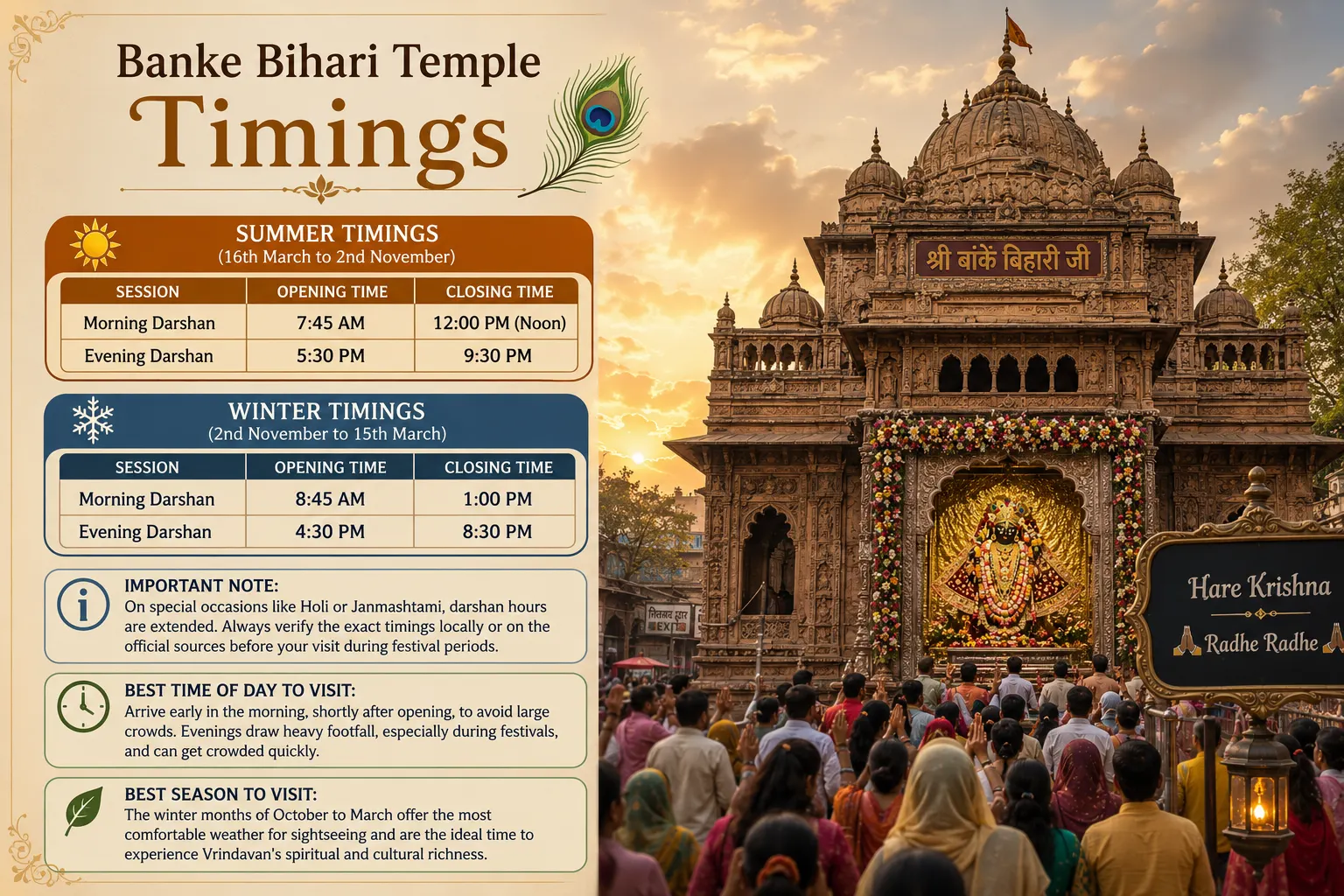
Summer Timings (16th March to 2nd November)
| Session | Opening Time | Closing Time |
|---|---|---|
| Morning Darshan | 7:45 AM | 12:00 PM (Noon) |
| Evening Darshan | 5:30 PM | 9:30 PM |
Winter Timings (2nd November to 15th March)
| Session | Opening Time | Closing Time |
|---|---|---|
| Morning Darshan | 8:45 AM | 1:00 PM |
| Evening Darshan | 4:30 PM | 8:30 PM |
- Important Note: On special occasions like Holi or Janmashtami, darshan hours are extended. Always verify the exact timings locally or on the official sources before your visit during festival periods.
- Best Time of Day to Visit: Arrive early in the morning, shortly after opening, to avoid large crowds. Evenings draw heavy footfall, especially during festivals, and can get crowded quickly.
- Best Season to Visit: The winter months of October to March offer the most comfortable weather for sightseeing and are the ideal time to experience Vrindavan’s spiritual and cultural richness.
The Daily Seva: Rituals at Banke Bihari Temple
The seva (service) at Banke Bihari Temple is performed in three phases every day. Each phase is deeply ceremonial and carries its own significance.
1. Shringar (Adornment)
The day begins with the Shringar ritual, where the idol of Banke Bihari Ji is bathed, dressed in fresh clothes, and adorned with jewellery and flowers.
The outfit and jewellery of the deity are changed multiple times each day, reflecting the loving care with which Bihari Ji is served. Shringar Aarti begins at 8:00 AM.
2. Rajbhog (Royal Offering)
In the late morning, a grand offering of food — called Rajbhog — is made to the Lord.
This is the most elaborate offering of the day and includes sweets, fruits, and a variety of freshly prepared items.
After this offering, the temple closes for the midday break.
3. Shayan (Rest)
In the evening, after the last session of darshan, the Shayan ritual takes place. The deity is put to rest with prayers and soft chanting.
This reflects the deeply human and tender relationship the priests share with their Lord.
Unique Traditions of Banke Bihari Temple
What truly sets the Banke Bihari Temple apart are its one-of-a-kind traditions. These are not found in any other temple in India.
Tradition 1: The Curtain Darshan (Parda)
This is the most iconic and talked-about tradition of the temple. Unlike most temples where devotees can view the deity continuously, at Banke Bihari Temple, a curtain (‘parda’) is drawn before the deity every few minutes.
This is based on the belief that the divine charm of Bihari Ji’s eyes is so intense that if a devotee looks into his eyes for too long, they may be rendered unconscious with spiritual ecstasy.
The curtain creates a unique rhythm of anticipation, joy, and longing in the hearts of devotees — as if the Lord himself is playing hide and seek with those who love him.
Tradition 2: No Mangala Aarti
At most major temples, the day begins with the Mangala Aarti — a prayer at dawn to wake the deity. The Banke Bihari Temple is one of the very few temples that do not observe Mangala Aarti.
This is because Bihari Ji is treated as an eight-year-old child, and devotees believe that the Lord should not be disturbed from his morning sleep after a night of Rasa dance with the gopis.
The Lord is believed to be a late riser — and his priests respect this.
Tradition 3: No Bell Ringing
In most temples, ringing bells is part of the worship ritual. At Banke Bihari Temple, bells are never rung.
Swami Haridas, who treated the deity like a young child, believed that loud bells would disturb and startle him.
This tradition continues to this day, keeping the atmosphere of the temple gentle and intimate.
Tradition 4: The Lotus Feet — Only on Akshaya Tritiya
The darshan of Banke Bihari Ji’s lotus feet is not available on regular days.
Only on Akshaya Tritiya — one of the most auspicious days in the Hindu calendar — are the feet of the Lord revealed to devotees. This makes that particular day extremely special and draws enormous crowds.
Tradition 5: The Flute — Only on Sharad Purnima
The flute of Banke Bihari Ji is played only once a year — on the eve of Sharad Purnima, the full moon night in the month of Kartik (October–November).
This is considered one of the most magical and spiritually charged moments at the temple.
Tradition 6: Holi — The Closest Darshan
During Holi, the deity is placed in a silver hut in the Jagmohan (main hall), allowing devotees to get closer than usual.
Priests sprinkle coloured water on the devotees as a form of divine blessing, making Holi at Banke Bihari Temple an unforgettable experience.
Banke Bihari Temple Dress Code
The Banke Bihari Temple has a dress code that asks all visitors to wear modest and traditional clothing, as a sign of respect for the sanctity of the space.
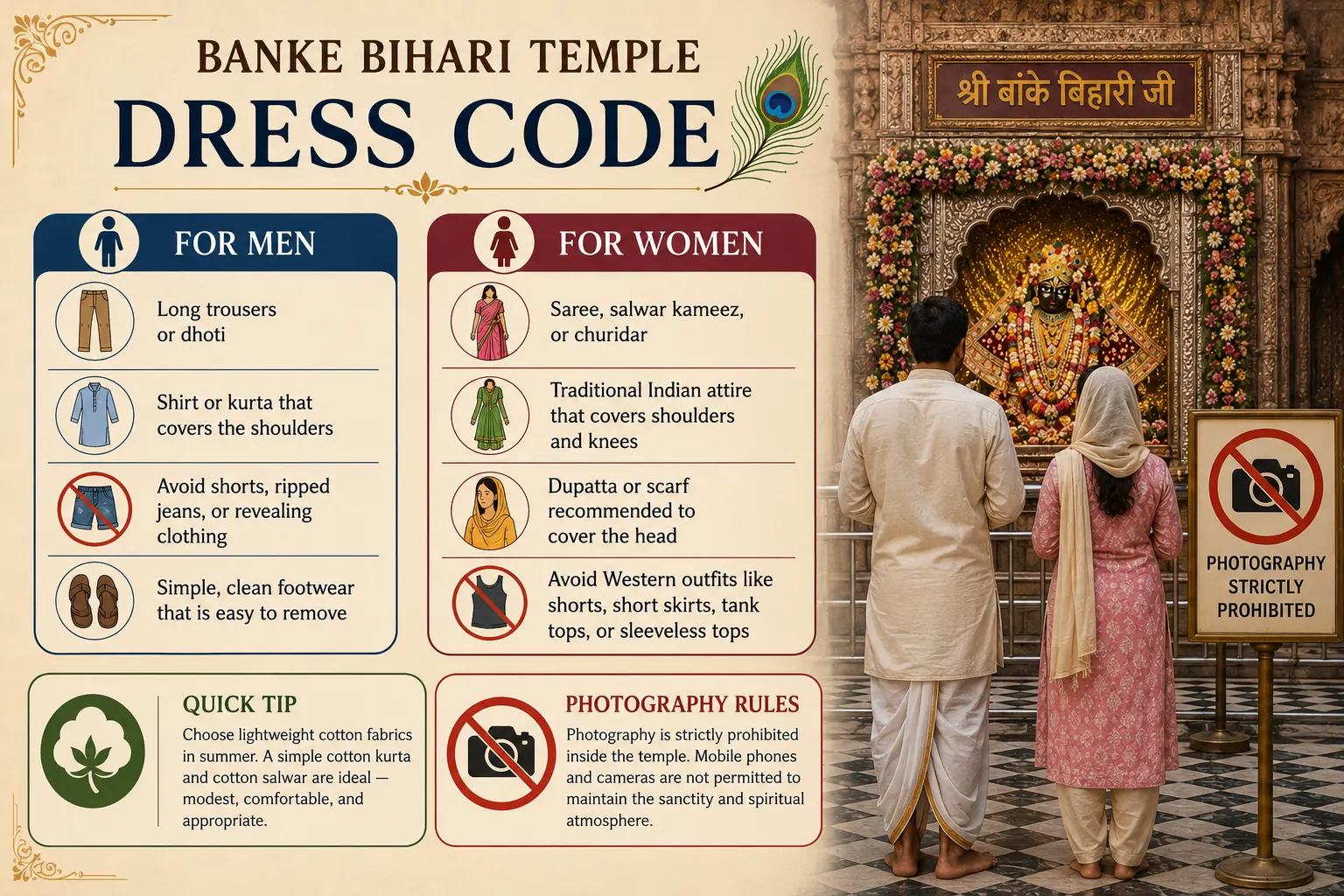
Dress Code for Men
- Long trousers or dhoti (traditional wraparound cloth)
- A shirt or kurta that covers the shoulders
- Avoid shorts, ripped jeans, or revealing clothing
- Simple, clean footwear that is easy to remove
Dress Code for Women
- Saree, salwar kameez, or churidar
- Any traditional Indian attire that covers the shoulders and knees
- A dupatta or scarf is recommended to cover the head inside the main shrine
- Avoid Western outfits like shorts, short skirts, tank tops, or sleeveless tops
Quick Tip: If you are travelling in summer and worried about the heat, choose lightweight cotton fabrics. A simple cotton kurta and cotton salwar are ideal — modest, comfortable, and appropriate.
Photography Rules
Photography is strictly prohibited within the temple premises. This rule applies to all visitors — tourists and devotees alike.
Mobile phones should be kept away, and cameras are not permitted. This is enforced to maintain the sanctity and spiritual atmosphere of the temple.
Is There an Entry Fee?
No. Entry and darshan at the Banke Bihari Temple are completely free of charge.
There is no ticket counter and no mandatory donation. However, you are welcome to contribute to the temple’s charitable activities if you wish.
How to Reach Banke Bihari Temple
Address: Banke Bihari Temple, Biharipura, Vrindavan, Mathura District, Uttar Pradesh – 281121
By Air
The closest airport is Indira Gandhi International Airport, New Delhi, which is approximately 161 kilometres from Vrindavan.
From Delhi, hire a private taxi or take a train to Mathura Junction.
By Train
The nearest railway station is Mathura Junction, which is well-connected to major cities across India.
Mathura Junction is approximately 12 kilometres from the Banke Bihari Temple. From Mathura, take an auto-rickshaw or tempo directly to Vrindavan.
By Road
Vrindavan is accessible by road from Delhi, Agra, Jaipur, and other major cities.
State buses, private buses, and taxis all serve the route. Once inside Vrindavan, auto-rickshaws and e-rickshaws are the easiest way to reach the temple.
Within Vrindavan
If you are already staying in Vrindavan, the temple is easy to reach by auto-rickshaw, cycle-rickshaw, or on foot if you are close to Biharipura.
Temples and Places to Visit Near Banke Bihari Temple
Vrindavan is a city full of sacred sites. Here are some must-visit places near the Banke Bihari Temple:
- Nidhivan — the sacred grove where Swami Haridas discovered the idol; believed to be the spot of Krishna’s nightly Rasa dance
- Prem Mandir — a magnificent modern temple with stunning white marble architecture and colourful night illuminations
- ISKCON Temple Vrindavan — a grand temple run by the International Society for Krishna Consciousness
- Radha Raman Temple — one of Vrindavan’s oldest and most revered temples
- Govind Dev Ji Temple — a historic temple established during the Mughal era
- Kesi Ghat — a sacred bathing ghat on the Yamuna River, ideal for a peaceful moment at dusk
Festivals at Banke Bihari Temple
The temple celebrates all major Hindu festivals with great joy, colour, and devotion. Here are the most important ones:
Janmashtami (August)
Janmashtami celebrates the birth of Lord Krishna. The Banke Bihari Temple is one of the most vibrant places in all of India to experience this festival.
Special darshans, devotional chanting, and a massive gathering of devotees make this an extraordinary occasion.
Holi (March)
Holi at the Banke Bihari Temple is legendary across India.
The deity is brought closer to the devotees, and priests sprinkle coloured water on the crowd.
Flower Holi, Lathmar Holi, and Rangwali Holi are all celebrated across Vrindavan during this season.
Jhulan Yatra — The Swing Festival
During Jhulan Yatra, the deity is placed on beautiful silver-plated swings and ceremonially swung. This festival recreates the joyful moments of Krishna swinging in the groves of Vrindavan with Radha and the gopis.
Radha Ashtami
Radha Ashtami marks the birth of Radharani, the consort of Lord Krishna. The temple is beautifully decorated, and special prayers are offered in her honour.
Sharad Purnima
This full moon night in the month of Kartik is particularly sacred at the Banke Bihari Temple.
The flute of the Lord is played on this night — and only on this night — making it one of the most anticipated moments of the temple calendar.
Practical Tips for Visitors
Before you visit, keep these practical tips in mind:
- Go early in the morning — the temple is least crowded just after opening. This is the best time for a calm and personal darshan experience.
- Keep your belongings close — the temple gets very crowded. Be mindful of your bags, phones, and valuables in the crowd.
- Watch out for monkeys — Vrindavan is home to many monkeys. They are generally harmless but are known to snatch eyeglasses, bags, and food items. Keep these close or out of sight.
- Remove your footwear — going barefoot inside the temple is a mandatory custom in India. There are shoe storage areas outside the entrance.
- No photography inside — all phones and cameras must be put away before entering. Respect this rule without exception.
- Stay hydrated — Vrindavan can get very warm, especially in summer. Carry a water bottle and rest in the shade when needed.
- Online darshan and donation — the temple offers an online darshan and donation facility for devotees who cannot visit in person.
Conclusion
The Banke Bihari Temple in Vrindavan is far more than a place of worship.
It is a living experience of divine love, ancient tradition, and deep devotion.
From the playful curtain darshans to the absence of morning aarti, every tradition here tells a story — of a God who loves like a child, a saint who sang with his whole heart, and a community of devotees who have kept that love alive for over five centuries.
Whether you are a first-time visitor or a lifelong devotee, this temple will move you in ways that are difficult to put into words.
Go with an open heart, dress respectfully, follow the traditions, and let Bihari Ji do the rest.
May the divine grace of Banke Bihari Ji fill your life with joy, devotion, and peace.
This article is written to help pilgrims and visitors plan a meaningful visit to the Banke Bihari Temple in Vrindavan, Uttar Pradesh. All timings and traditions are based on well-known and consistently reported information. For the most current darshan timings and festival schedules, please verify locally at the temple or through official Vrindavan temple sources.