
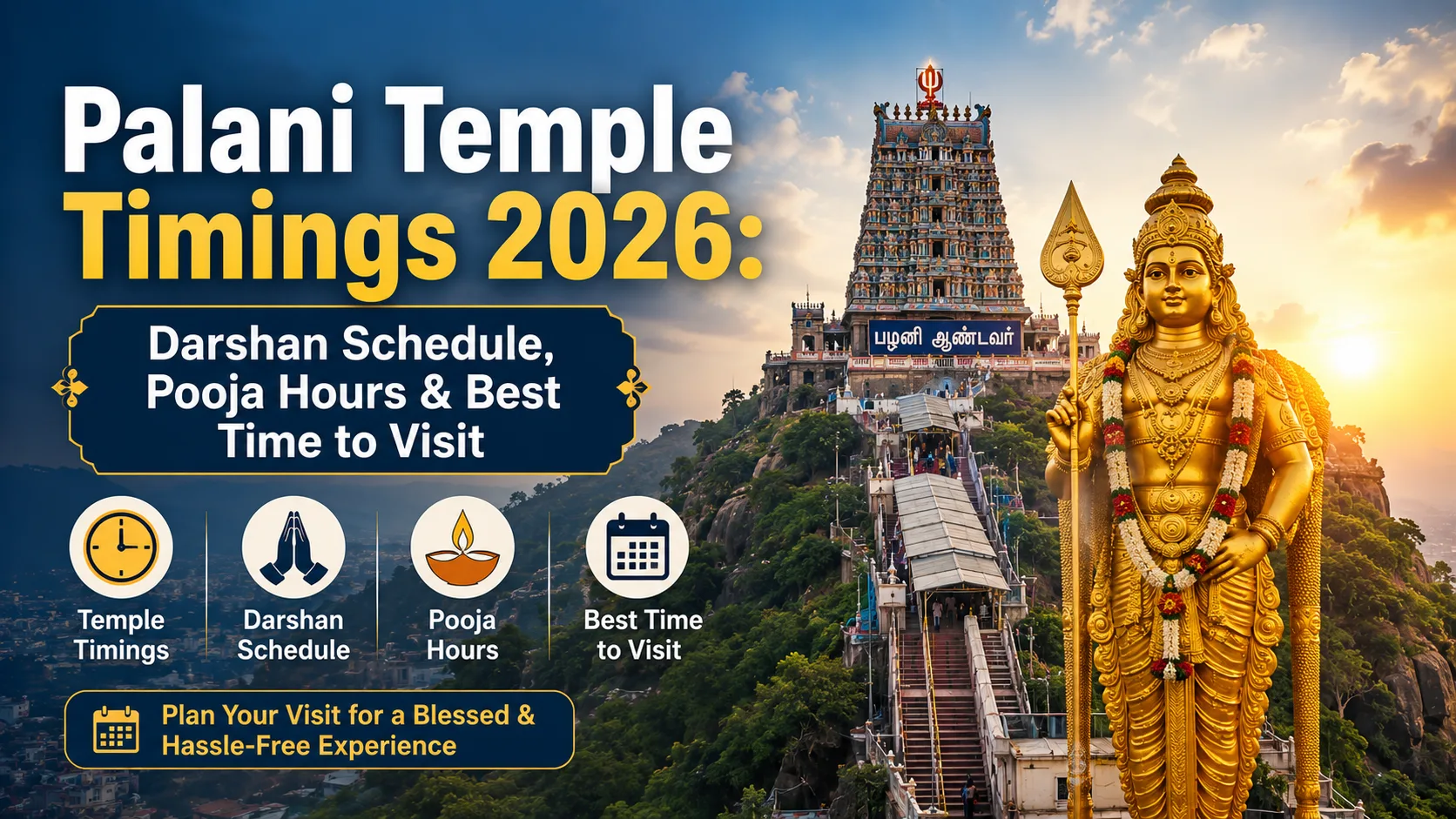
Introduction
Are you planning a pilgrimage to Palani? Then, knowing the temple timings is the very first step.
The Arulmigu Dhandayuthapani Swamy Temple in Palani, commonly known as the Palani Murugan Temple, is one of the holiest shrines in all of South India.
It sits on top of the Sivagiri Hill, rising about 1,500 feet above the surrounding plains of the Dindigul District in Tamil Nadu.
Every single day, thousands of devotees climb 693 stone steps or take the rope car to seek the blessings of Lord Murugan, the warrior son of Lord Shiva.
But here is the truth. Arriving at the wrong time means missing the key poojas. It means longer queues, closed doors, or an unnecessarily rushed darshan.
This complete 2026 guide solves all of that. We cover the daily darshan schedule, all six kala pooja timings, rope car hours, online booking steps, festival schedule, dress code, and the absolute best time to visit for a calm and spiritually fulfilling experience.
Read on and plan your trip with complete confidence.
What Is the Palani Temple?
The Palani Temple, officially known as Arulmigu Dhandayuthapani Swamy Temple, is one of the Arupadai Veedu, the six sacred abodes of Lord Murugan, and is widely regarded as the second most important after Thiruchendur among devotees from Tamil Nadu and across South India.
The presiding deity is Lord Dhandayuthapani, a unique and deeply symbolic form of Lord Murugan.
Unlike the warrior form seen in most other Murugan temples, here the Lord holds only a dhandam (a simple staff or walking stick).
He stands alone, without his divine consorts Valli and Devasena. This form represents renunciation, wisdom, and spiritual austerity.
The word “Dhandayuthapani” itself means “the Lord who holds the danda (staff) as his weapon” – signifying that knowledge and discipline are the greatest powers.
This temple is a place that belongs to every devotee, those seeking good health, those beginning new ventures, students praying for wisdom, parents seeking blessings for their children, and pilgrims who have walked barefoot for days to fulfil a vow.
History of Palani Temple
The Legend of Gnanapazham — The Fruit of Knowledge
The origin story of the Palani Temple is one of the most beloved tales in Tamil devotional literature.
According to the legend, the divine sage Narada once brought a rare and precious fruit, the Gnanapazham (Fruit of Knowledge), to Mount Kailasa, the abode of Lord Shiva and Goddess Parvati.
He declared that this fruit should be given to the most deserving among all the gods. A contest was announced. Both Lord Murugan and Lord Ganesha were asked to circumnavigate the entire universe. The one who completed the journey first would receive the fruit.
Lord Murugan immediately mounted his peacock and set off on the great journey.
Lord Ganesha, however, simply walked around his parents, Lord Shiva and Goddess Parvati, and declared that for him, his parents were the entire universe.
Moved by this profound wisdom, the fruit was awarded to Lord Ganesha.
Lord Murugan was deeply disappointed. He left Mount Kailasa and came alone to the Palani Hills, giving up all his weapons, ornaments, and companions.
He embraced the life of a renunciate yogi, holding only a simple staff.
It was in this state of serene detachment and wisdom that he became Dhandayuthapani, the Lord of Palani.
The Navapashanam Idol — Created by Sage Bogar
The central idol at Palani Temple is extraordinarily unique in all of India.
It was crafted by Siddhar Bogar (also known as Bhogar), one of the 18 great Tamil Siddhars, sage-alchemists who mastered both spiritual knowledge and herbal medicine.
Bogar created the idol using Navapashanam, a sacred compound of nine powerful medicinal minerals and herbs.
The exact composition of Navapashanam is kept secret and has been debated by scholars and scientists for centuries.
What is widely believed is that the combination carries natural healing properties.
Devotees believe that the water (Abhishekam theertham) that is used to bathe the idol absorbs the medicinal properties of the Navapashanam and is distributed to devotees as holy water.
Thousands collect this sacred water, believing it carries healing energy and divine blessings.
This unique idol is what sets Palani Temple apart from every other Murugan shrine in the world.
Royal Patronage Through the Centuries
The temple has received patronage from several great dynasties over the centuries.
The Chera kings laid the early foundation between the 2nd and 5th centuries CE.
The Chola dynasty expanded the temple and left inscriptions recording their grants and endowments.
The Pandya rulers further enhanced their architecture, including the covered praharams and intricate sculptures.
The Vijayanagar Empire continued its patronage between the 14th and 16th centuries.
Today, the temple is managed by the Arulmigu Dhandayuthapani Swamy Thirukoil Trust, under the supervision of the Hindu Religious and Charitable Endowments Department of the Tamil Nadu Government.
Palani Temple Timings 2026: Complete Daily Schedule
The temple is open 365 days a year. Below is the complete and verified darshan schedule for 2026.
Regular Day Darshan Timings
| Session | Timing |
|---|---|
| Morning Darshan Opens | 5:45 AM |
| Morning Darshan | 5:45 AM – 12:30 PM |
| Afternoon Break (Rituals) | 12:30 PM – 1:30 PM |
| Evening Darshan | 1:30 PM – 9:00 PM |
| Temple Closes | 9:00 PM |
Festival Day Darshan Timings
On major festival days, the temple opens earlier and stays open much longer to accommodate lakhs of devotees.
| Session | Timing |
|---|---|
| Early Morning Darshan | 4:00 AM |
| Full-Day Darshan | 4:00 AM – 9:00 PM+ |
| Temple Closes | After final rituals (may extend past midnight during Thai Poosam) |
Important: Timings are subject to change on special festival days, Rahu Kala periods, and during Abhishekam. Always verify through the official website at palanimurugan.hrce.tn.gov.in before your visit.
Palani Temple Pooja Timings: All Six Kala Poojas
The Palani Temple performs six Kala Poojas (Alangarams) every single day. These are the most sacred moments of the day when the Lord is bathed, adorned, and offered rituals in a specific sequence. During each pooja, the sanctum is closed for about 30–45 minutes.
Here is the complete six-kala pooja schedule:
| Pooja Name | Time |
|---|---|
| Thiruvanandal (Vishwaroopa Darshan) | 5:40 AM – 6:00 AM |
| Ushakkala Pooja | 6:00 AM – 6:30 AM |
| Kalasandhi Pooja | 8:00 AM – 8:30 AM |
| Uchikkala Pooja (Noon Pooja) | 12:00 PM – 12:30 PM |
| Sayaratchai Pooja (Evening Pooja) | 6:00 PM – 6:30 PM |
| Ardhajama Pooja / Palliyarai (Night Pooja) | 8:00 PM – 8:30 PM |
Tip: During pooja times, devotees cannot enter the sanctum directly. You can still observe from outside. If you specifically want to witness a pooja, arrive 10–15 minutes before the scheduled start time and join the crowd near the entrance to the inner shrine.
What Happens During Each Pooja?
Each pooja has its own significance and ritual sequence. Here is a brief explanation:
Thiruvanandal (Vishwaroopa Darshan): This is the first opening of the day. The sanctum doors are opened after the Lord’s morning ablutions. It is the most spiritually charged moment and gives devotees the first darshan of the freshly adorned deity.
Ushakkala Pooja: The morning pooja where the Lord is offered flowers, incense, and lamps. The chanting of Thirumurugatrupadai, a classic Tamil hymn, fills the air.
Kalasandhi Pooja: The mid-morning pooja. The deity is adorned in a specific alangaram (decorative attire) and worshipped with devotional offerings.
Uchikkala Pooja (Noon Pooja): This is the most elaborate pooja of the day. A full Rajbhog (royal food offering) is made to the Lord. The idol is adorned in grand attire, and the rituals are performed with great ceremony.
Sayaratchai Pooja (Evening Pooja): As the day draws to a close, the deity is adorned in evening attire. This is a beautiful time to be at the temple as the golden light of dusk fills the hilltop and the fragrance of incense drifts across the prakarams.
Ardhajama Pooja / Palliyarai (Night Pooja): The final ritual of the day. The Lord is put to rest with prayers and gentle hymns. After this pooja, the sanctum doors are closed for the night.
Abhishekam Timings at Palani Temple
The Abhishekam, the sacred bathing ritual of the deity, is one of the most sought-after experiences at Palani Temple.
Devotees who attend the Abhishekam receive the theertham (holy water that has flowed over the Navapashanam idol), believed to carry healing and divine energy.
Special Abhishekam can be booked by devotees for a nominal fee. The general Abhishekam is performed during the regular pooja schedule.
Book this in advance through the official portal to avoid missing your slot.
Rope Car & Winch Service Timings
The Palani Temple sits on top of Sivagiri Hill. To reach the sanctum, devotees have three options:
- Climb the 693 stone steps on foot — the traditional and spiritually meritorious way
- Rope Car (Cable Car) — for a scenic, comfortable ascent
- Winch Service — a separate rail-based lift facility, preferred for older devotees and children
Rope Car Timings
| Day Type | Operating Hours |
|---|---|
| Regular Days | 7:00 AM – 9:00 PM |
| Festival Days | 4:00 AM – 9:00 PM (extended) |
The rope car takes approximately 3 minutes to cover the 323-metre ascent. During peak hours, the car operates every 5 minutes.
Winch Service Timings
| Day Type | Operating Hours |
|---|---|
| Regular Days | 5:00 AM – 9:00 PM |
| Festival Days | 4:00 AM – Extended |
Three winch units are operated simultaneously. This service is specifically recommended for older citizens, children, and disabled devotees.
Important: On major festival days like Thai Poosam and Panguni Uthiram, both the rope car and winch see extremely long queues. On such days, climbing the steps may actually be faster. Plan accordingly.
How to Book Palani Temple Darshan Online
The Palani Temple Trust offers online booking for special darshan slots, poojas, and Abhishekam. Here is how to do it step by step:
Step 1: Visit the official temple website — palanimurugan.hrce.tn.gov.in
Step 2: Go to the “Online Services” or “Ticket Booking” section on the homepage.
Step 3: Register or log in using your mobile number and a valid email address.
Step 4: Select the type of service — special darshan, Abhishekam, or a specific pooja seva.
Step 5: Choose your preferred date and time slot from the available options.
Step 6: Enter the names and ID details of all devotees in your group.
Step 7: Complete the payment securely through the online payment gateway.
Step 8: Download your e-ticket. A QR code will be sent to your mobile number.
Step 9: Carry your e-ticket (printed or on your phone) along with a valid government-issued photo ID on the day of your visit.
Pro Tip: Book at least 10–15 days in advance during Thai Poosam, Panguni Uthiram, and Skanda Sashti. Early morning slots fill up fastest, so act quickly when the booking window opens. Weekday slots are easier to secure than weekend or public holiday slots.
Special Darshan Ticket Price
| Darshan Type | Price |
|---|---|
| General Free Darshan | Free |
| Special Darshan (Paid) | Rs. 50 per person onwards |
| Abhishekam Booking | Varies by seva type |
Prices may be revised. Always verify the current rates on the official temple website or at the on-site booking counter before your visit.
Dress Code at Palani Temple
The Palani Temple has a specific dress code that all visitors must follow as a mark of respect and devotion.
For Men
- Traditional attire is mandatory inside the sanctum area.
- Men must wear a dhoti (veshti) or lungi — not trousers, jeans, or shorts.
- Going bare-chested with a dhoti is the traditional and accepted form of dress inside the inner sanctum.
- Shirts and kurtas are acceptable in the outer prakarams.
For Women
- Saree, salwar kameez, or churidar with dupatta is appropriate.
- Traditional attire is preferred. Avoid Western outfits such as shorts, jeans, or sleeveless tops inside the temple.
- A dupatta or shawl to cover the head in the inner sanctum is recommended.
Footwear
- Remove all footwear before climbing the steps or entering the temple premises.
- Footwear storage facilities are available at the base of the steps and near the temple entrance.
Photography
- Photography is not permitted inside the main sanctum.
- Phones should be stored away near the inner shrine area.
Best Time to Visit Palani Temple in 2026
Choosing the right time to visit can completely transform your experience. Here is a clear breakdown:
Best Season: October to March
The cooler winter months are by far the best time for a Palani visit. The weather is pleasant, the hill climb is comfortable, and the crowds are manageable on weekdays.
Best Day of the Week: Tuesday to Thursday
Weekdays, especially mid-week, are significantly less crowded than weekends.
Tuesday is auspicious for Lord Murugan, and while devotees do visit on this day, it is still far less crowded than a Sunday or a festival weekend.
Best Time of Day
Early Morning (5:45 AM – 8:00 AM): This is the absolute best window. The Thiruvanandal Darshan at dawn is deeply moving. The crowd is thin, the air is cool, and the temple carries a magical stillness. The Ushakkala and Kalasandhi poojas give you a front-row spiritual experience.
Evening (6:00 PM – 8:00 PM): Evenings at the hilltop are beautiful. The sunset view from Sivagiri Hill is stunning, and the Sayaratchai evening pooja is a highlight of the day. Crowds are moderate during the week.
When to Avoid
Avoid Sunday mornings, public holidays, and the days immediately surrounding major festival dates if you are looking for a peaceful darshan.
During Thai Poosam and Panguni Uthiram, the temple sees enormous crowds, wonderful for the festive experience, but challenging if you want a calm visit.
Festivals at Palani Temple 2026
The Palani Temple celebrates several grand festivals throughout the year. Each one draws lakhs of devotees from Tamil Nadu and beyond.
Thai Poosam (Thaipusam) — January/February 2026
This is the most celebrated festival at Palani. It falls on the full moon day of the Tamil month of Thai, when the moon is in conjunction with the Poosam (Pushya) star.
Devotees carry elaborate, decorated Kavadi frames balanced on their shoulders as an act of penance and devotion.
Massive processions move through the streets of Palani as lakhs of pilgrims complete foot pilgrimages (pada yatra) from distant towns to fulfill their vows.
The temple remains open through the night during Thai Poosam.
Panguni Uthiram — March/April 2026
This ten-day festival celebrates the celestial wedding of Lord Murugan and Devasena. Elaborate processions, special poojas, and large gatherings make this one of the most visually spectacular events at the temple. The Ther (chariot) procession on the final day is a highlight.
Vaikasi Visakam — May/June 2026
Vaikasi Visakam celebrates the birth star of Lord Murugan. Ten days of festivities include special alankaram (decoration) of the deity, cultural events, and large darshan gatherings.
Skanda Sashti — October/November 2026
This six-day festival commemorates Lord Murugan’s victory over the demon Soorapadman. The Soorasamharam (re-enactment of the battle) on the sixth day is a dramatic and deeply devotional event. The temple witnesses huge footfall across all six days.
Karthigai Deepam — November/December 2026
The festival of lights is celebrated with thousands of lamps lit across the temple and hilltop. On this occasion, the temple opens from 4:00 AM, earlier than usual, and remains open till Rahu Kala. The view of the illuminated hilltop is breathtaking.
Aani Thirumanjanam (Annual Abhishekam) — June/July 2026
This is the most important Abhishekam of the year, performed annually on a grand scale. Special medicinal herbs and sacred substances are used to bathe the Navapashanam idol.
Devotees attending this event receive the most potent Abhishekam theertham of the year.
How to Reach Palani Temple
Official Address: Arulmigu Dhandayuthapani Swamy Temple, 315 Head Office, North Giri Street, Palani, Dindigul District – 624601, Tamil Nadu
By Air
The nearest airport is Madurai Airport (IXM), approximately 110–140 km from Palani. From Madurai, hire a taxi or take a state bus to Palani.
Coimbatore International Airport is approximately 100 km away and is another convenient option for those flying in from northern India or abroad.
By Train
Palani Railway Station is directly in the town, just 2.3 km from the temple. Direct trains connect Palani to Chennai, Coimbatore, Madurai, Tiruppur, and Erode.
Dindigul Railway Station is approximately 60 km away and serves as a major hub for trains from across India.
By Road
Palani is well-connected by road from all major cities in Tamil Nadu and neighbouring states:
| City | Distance from Palani | Approx. Travel Time |
|---|---|---|
| Coimbatore | 100 km | 2 hours |
| Madurai | 110 km | 2.5 hours |
| Dindigul | 60 km | 1.5 hours |
| Chennai | 450 km | 7–8 hours |
| Bangalore | 310 km | 5–6 hours |
| Tiruppur | 65 km | 1.5 hours |
Direct state-run buses (SETC and TNSTC) and private buses operate from Chennai, Coimbatore, Madurai, Tiruppur, Salem, Bangalore, and Tirupati to Palani.
Panchamirtham — The Sacred Prasad of Palani
No visit to Palani Temple is complete without receiving and tasting Panchamirtham, the unique and beloved prasad of Lord Dhandayuthapani.
Panchamirtham is a sweet, aromatic mixture made from five natural ingredients: bananas, jaggery, honey, cardamom, and ghee.
It is prepared fresh every day within the temple premises and is offered to the deity before being distributed to devotees.
The Palani Panchamirtham has a Geographical Indication (GI) tag — making it a protected regional product of India.
The authentic Panchamirtham is available only at the official temple counters and should not be bought from roadside vendors.
Always purchase from authorised temple stalls to ensure you receive the genuine preparation.
Practical Tips for Visiting Palani Temple in 2026
These tips will help you have a smooth and spiritually fulfilling visit:
- Start early. The temple opens at 5:45 AM. Arriving early means cooler temperatures, thinner crowds, and the best chance to witness the morning poojas. During summer, early morning is essential.
- Wear traditional attire. Men should carry a dhoti (veshti). You can change at the facilities near the temple base before climbing.
- Book online in advance. For special darshan, Abhishekam, or pooja seva — always book online through the official site at least 7–10 days ahead.
- Carry a valid ID. A government-issued photo ID is required for online booking redemption and for some special seva entries.
- Climb the steps if you can. The 693 steps are a spiritual act of devotion. Devotees believe that climbing the steps barefoot is meritorious. If you are physically able, consider it.
- Use a winch for older members. The winch service is safe, convenient, and specifically designed for older citizens, children, and those with physical limitations.
- Buy Panchamirtham only from official counters. Do not purchase from street vendors outside the temple.
- Carry water while climbing. The step climb can be tiring, especially in summer. Carry a water bottle for the ascent.
- No photography inside the sanctum. Keep your phone away when entering the main shrine.
- Check for Rahu Kala. The temple may suspend darshan during Rahu Kala on certain days. Check this before planning your arrival time.
- For festival visits, arrive 2–3 hours early or book VIP/special darshan online well in advance. Queues during Thai Poosam and Skanda Sashti can be several hours long.
Places to Visit Near Palani Temple
While you are in Palani, take time to visit these nearby attractions:
- Thiru Avinankudi Temple (Murugan Temple at the Foothills): Located at the base of the Palani Hill, this small Murugan shrine is where Lord Idumban is worshipped. Devotees traditionally visit this temple before climbing the steps.
- Bogar’s Cave (Siddhar Cave): Located within the Palani Hill, this cave is associated with Siddhar Bogar — the sage who created the Navapashanam idol. The cave is considered highly sacred.
- Varathamanathi Dam: Located approximately 9 km from Palani, this scenic dam and reservoir is a peaceful spot for a post-temple visit.
- Kodaikanal: The famous hill station is approximately 65 km from Palani and is a beautiful extension to any Palani pilgrimage trip.
- Dindigul Rock Fort: Approximately 60 km away, the historic rock fort in Dindigul is a worthwhile heritage visit.
Conclusion
The Palani Murugan Temple is not just a destination. It is a journey that begins the moment you decide to go, and one that stays with you long after you come home.
Whether you climb all 693 steps as an act of devotion or gently ascend in the rope car with your family, the experience of standing before Lord Dhandayuthapani on the Sivagiri Hill is unlike anything else.
The Navapashanam idol, the healing theertham, the fragrant Panchamirtham, the panoramic views, and the six daily poojas all come together to create a pilgrimage that is complete in every sense.
Plan your visit using the 2026 timings and schedule in this guide. Go early. Dress traditionally. Book online if you want a special darshan.
And let Lord Murugan, the renunciate who gave up everything and found everything, guide your path.
Vel Muruga! Har Har Muruga!
Complete guide to Palani Temple timings 2026, daily darshan hours, six kala pooja schedule, rope car timings, online booking steps, dress code, and best time to visit. Updated and verified for 2026.
Tags: Palani Temple timings, Palani Murugan Temple 2026, Arulmigu Dhandayuthapani Swamy Temple, Palani darshan schedule, Palani pooja timings, Palani rope car timings, Palani Temple online booking, Thai Poosam 2026, Navapashanam idol Palani, Palani Panchamirtham, best time to visit Palani Temple
This article is written to help pilgrims and visitors plan a well-informed visit to the Arulmigu Dhandayuthapani Swamy Temple in Palani, Tamil Nadu. All timings, historical details, and travel information are based on verified sources, including the official temple website (palanimurugan.hrce.tn.gov.in) and authoritative temple guides. For the most current darshan schedule and festival timings, always verify directly at the official website.